wear · were · where · we’re
wear /wɛr/ · were /wɜːr/ · where /wɛr/ · we’re /wɪər/ — three different vowel sounds. wear and where are homophones; were (/ɜːr/ like bird) and we’re (/wɪər/ like here) each sound distinct.
Four common words — three different sounds. wear and where are perfect homophones: /wɛr/. were has a deeper r-coloured vowel: /wɜːr/ (like her, bird). we’re (contraction of we are) has yet another vowel: /wɪər/ (like here, beer).
wear = where
/wɛr/
homophones
were
/wɜːr/
like her, bird
we’re
/wɪər/
like here, beer

verb — to have clothing on your body — 'wear a coat' · 'what are you wearing?' · 'wear out'
mouth shape
diph /ɛr/ — mouth opens to /ɛ/ then moves into an R — like 'there', 'care', 'fair'
wear
/wɛr/
vowel length
plays as: “what to wear”
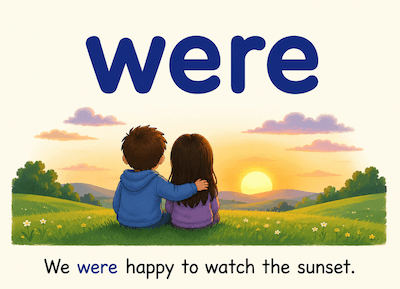
past tense of 'be' — used with we/you/they — 'we were happy' · 'they were late'
mouth shape
long /ɜːr/ — tongue mid-central, lips relaxed, R-coloured — like 'her', 'stir', 'bird'
were
/wɜːr/
vowel length
plays as: “we were there”
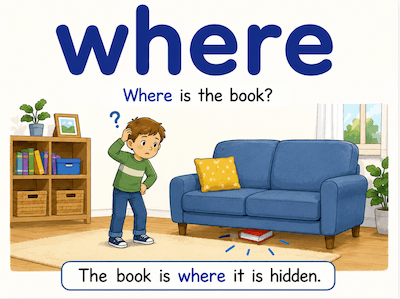
question word / conjunction — asking about a place — 'where are you?' · 'the town where I was born'
mouth shape
same as wear — /ɛr/ — wear and where are perfect homophones
where
/wɛr/
vowel length
plays as: “where are you”

contraction of 'we are' — 'we're ready' · 'we're going home' · often confused with 'were' in writing
mouth shape
diph /ɪər/ — start with /ɪ/ (like 'bit') then glide into R — like 'here', 'beer', 'near'
we're
/wɪər/
vowel length
plays as: “we're ready”
Key difference — three vowels
wear / where /ɛr/: mouth opens to /ɛ/ (like bed) then curves into R — like there, care, fair.
were /ɜːr/: deeper, longer vowel — tongue mid-central, lips relaxed — like her, stir, bird.
we’re /ɪər/: starts with the short /ɪ/ (like bit) then glides into R — like here, beer, near.
Why were/where sound blurry on YouGlish
Reminder: where is pronounced exactly like wear — always, in every context. If you can already say “wear”, you already know “where”.
were has a weak form. Said alone or emphasized, it’s the full /wɜːr/ — deep, like her. But were is an auxiliary verb, and in real, connected speech auxiliaries almost always get swallowed toward a quick schwa: /wər/. “We were there” is usually said we-wer-there, not we-WUR-there. That reduced sound drifts close to where /wɛr/, which almost never reduces (it’s a question word carrying real meaning, so it keeps its full vowel and often its own stress). This is a genuine feature of natural English, not a flaw in the recording — even native speakers can’t always tell them apart by ear alone at normal speed.
Two things that actually help: (1) listen for stress — “were” on its own at the end of a sentence (“Yes, we were.”) or being emphasized (“we WERE invited”) pops back to the full, clearly-different /wɜːr/; (2) lean on grammar over sound — “were” always follows a subject (we/you/they were), “where” always opens a question or points to a place.
Hear the difference by position
Browser text-to-speech applies stress inconsistently — for genuine natural emphasis, the YouGlish clips below (real speakers) are more reliable than this synthetic voice.
Example sentences
wear:“What will you wear to the party?”
wear:“These shoes wear out very quickly.”
were:“We were at the concert last night.”
were:“They were not expecting this.”
where:“Where are you going?”
where:“I don’t know where she lives.”
we’re:“We’re going to be late — hurry up!”
we’re:“We’re ready whenever you are.”
Hear it in a sentence
“She didn't know what to wear to the interview, so she kept it simple.”
“They were already on the train when they realised they had the wrong tickets.”
“He couldn't remember where he had parked the car.”
Hear it in the wild
Real speech from native speakers — the most reliable way to check a pronunciation, since automated audio can vary by device and browser.
wear
Hear native speakers say “wear” in real sentences — news, lectures, and podcasts.
Opens YouTube-sourced clips in a new tab.
were
Hear native speakers say “were” in real sentences — news, lectures, and podcasts.
Opens YouTube-sourced clips in a new tab.
where
Hear native speakers say “where” in real sentences — news, lectures, and podcasts.
Opens YouTube-sourced clips in a new tab.
we're
Hear native speakers say “we're” in real sentences — news, lectures, and podcasts.
Opens YouTube-sourced clips in a new tab.
How teachers explain this
Approved tips from the community, sorted by helpfulness
Word families
wear family ▸
where family ▸
Comments
Comments are reviewed before they appear publicly.